We returned to Cameroon early in October so that I may resume work with the Maga council while VSO continues to look for a replacement for me. We flew into Douala and the next day went to Yaounde. We had to spend a few days there waiting for a booking for the train to Ngaoundere. The transport system was choked up because of an African Cup qualifier match in Garoua between Cameroon and the Congo. Other than flying, which is very expensive and somewhat unreliable (since I wrote this I have heard that all flights to Maroua have been suspended indefinitely), the only way to get to the Far North is through Ngaoundere and then by bus through Garoua to Maroua. FIFA had been asked to relocate the match because of a cholera outbreak in Garoua but this request had been refused. Maroua is referred to as the epicentre of the cholera outbreak, which is the worst for over 20 years. This is covered in my next post.
The rains have lingered longer than usual this year, the countryside is greener than usual and many rivers passed on the journey from Yaounde to Maroua were fuller than I have ever seen them. The elephants which leave the Waza wildlife park for a few months towards the end of the rainy season to roam south, passing not far from Maga, have travelled much longer distances than usual and have caused a lot of damage to crops on their way. I have never seen them, even on visits to the park.
I got a very warm welcome from a large number of people on returning to Maga. My bicycle is not yet working but every time I walk somebody gives me a lift on their moto. The violent storms this year damaged much of the millet crop and some of the rice crop in Maga but conditions are favourable for the coming red millet crop. The level of Lake Maga is very high but the dyke has not been breached, as had been feared. It is currently difficult to catch fish because the water is too deep but fish stocks will benefit. By all accounts most of Maga was flooded for a large part of the rainy season and many houses made of mud have crumbled. I am in a privileged position of having a house made of concrete but there were two out-houses in my enclosure which are now rubble.
Before leaving Maga the mayor and I had got agreement from SEMRY, a local development organisation, that they would use their machinery to prepare the (mud) roads for the rainy season if I paid the fuel costs. I handed over the money for the fuel in May but unfortunately some authorisation problems in SEMRY delayed the work until the worst of the rains were over. It still made a small difference because channels were dug at the sides of the roads into which the flood waters flowed. Now the mounds of earth removed from these channels are dumped along the roadsides but I am assured that they will eventually be smoothed out. Hopefully all this will make a significant difference for the next rainy season.
When I first returned to Maga there had been no electricity or running water for over two weeks but happily these have been fixed now. My first journey to Maga was difficult since the bus broke down and a second bus had to be sent from Maroua. This also broke down several times and it got stuck in the mud and people had to get out and push. One of our breakdowns was beside a tiny village and I was pleased to see a poster on a tree giving advice on cholera. My trips to Maga have been much more difficult than the trips back, as though the buses don’t want to go there. A new bus company set up last year initially had good buses but the terrible state of the roads has taken its toll and the buses are now nearly as bad as the awful ones they replaced.
Even the roads in Maroua are very bad after the rains and they make travel hazardous. On “surfaced” roads people weave from side to side avoiding potholes and on unsurfaced roads negotiating the humps and hollows is like skiing through a mogul field. The rules of the road are disregarded and it is necessary always to anticipate what other drivers and moto riders will do. While we were away a woman who sold koki (a dish made from beans) at the roadside next door to our house was killed by a car that went out of control and hit a pole which fell on her. Her baby survived. A few days ago a van went out of control near by and crashed into a wall, ending up in somebody’s enclosure. Our stretch of road in Maroua has had its share of incidents. Last year Aicha saw a man being gored by a bullock just outside our house.
We have had some macabre news from Foumban, Aicha’s home village in West Cameroon. There is a police/army unit trained to track down the coupeurs de route (the bandits who hold up buses and other vehicles and rob the passengers and sometimes kill them). A member of this unit was in league with some bandits and he shot a moto-taximan in a hold-up. The latter survived and identified his attacker. Local people lynched him by putting a tyre doused in petrol around him and setting it alight. When we last visited Foumban this man’s father had shot himself and this was the main talking point on that occasion.
On a lighter note, I went to have my hair cut in Maga. The usual barber was not there and the one I went to immediately set upon me, taking huge chunks of hair off my head. I stopped him and walked out, but it was too late. My head looked like one of the local fields devastated by the storms. When I got to Maroua I got a local barber to reduce my hair to the lowest common denominator and now I look like Yul Brynner (for those of you who are not old enough to remember him, he made complete baldness fashionable). Aicha has still not stopped laughing but happily I had lent my camera to somebody so she hasn’t yet been able to take photos for home.
Saturday, October 30, 2010

Saturday, August 28, 2010
"Leaving" Maga


I am currently back in Ireland having completed my contract in Maga at the end of May but I have agreed to return in October since VSO has not yet found a replacement for me. Four years of the plan to build the capacities of the council remain and the need for a volunteer is very real. While I have found my work in Maga rewarding and feel that it has made a difference, I think that at this stage it would be good to bring in somebody with fresh ideas and energy. However the council is currently going through a critical phase due to the roll-out of decentralisation in Cameroon so it is vital to have a volunteer there in the coming months. Also if a replacement is found it would be useful to have a face-to-face hand-over. Further, although there has been good progress on some of the projects which I helped to initiate, my presence would be beneficial on this front. The opportunities for adding value both to the council and to the people in Maga are enormous.
We then travelled to West Cameroon to visit Aicha’s family in Foumban and I returned to Ireland in mid-June. For the early weeks I did little more than watch the football World Cup on television. Cameroon’s early exit was not a surprise since although they had good players they were not well prepared. However my allegiance switched to Ghana, the only African team to make it to the knock-out stage, until their unfair exit (reminiscent of Ireland’s unfair exit at the qualifier stage, which was greeted with huge indignation in Cameroon where “la main de Thiery Henry” has since become part of everyday language). Aicha joined me a few weeks later after the usual delay with her visa. She has settled very well, her English is improving all the time and she is making a promising start to golf. The highlight of our visit to Ireland was a trip to Sligo with Ruth, an English volunteer who worked in schools in Maga when I first went there and who has now bravely gone to Afghanistan. We visited various megalithic sites and went to some traditional music sessions. At one of these we were prevailed on to try some set dancing. Aicha took to this like a duck to water and was a big hit with the locals.
Having gone through a collapse of interest and motivation on returning to Ireland, as also happened last year, I am now beginning to think forward to my return to Maga. After struggling through the rainy season in my first year in Maga I decided to skip it in future years. The tragic events in Pouss (see my previous post) give a vivid illustration of how hard and perilous life is there. Latest information gives more than 5,000 made homeless by the storms in addition to the dead and injured and the crop damage. One of the villages where cholera has broken out is in a remote part of the county and the rains cut access to health centres for its sick people and access to markets for its farmers: one of the projects that I have helped to initiate is the building of a “road” through that village which would give such access throughout most of the rainy season. This year’s rainy season is by all accounts exceptionally bad and has caused widespread access problems and power cuts even in Maga, Pouss and Guirvidig, the three biggest villages. 2010 has been a year of extremes, with an exceptionally bad harmattan (wind with dust from the Sahara), exceptionally hot weather from February to May and now exceptionally severe rains and storms. One piece of good news amid the gloom is that state assistance for work on drawing up the council’s development plan, which will give a sound context for development of roads, schools, health centres, provision of wells and piped water, electrification and other infrastructure has come through after years of delay. This is something that I hope to contribute to when I return.
Tuesday, August 24, 2010
Sad News from Maga


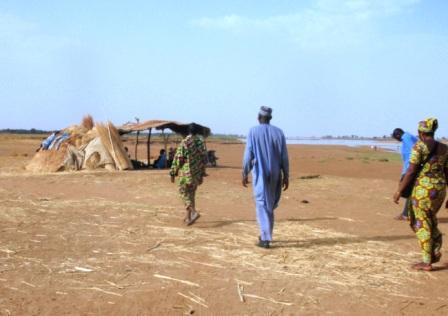


In July, while back in Ireland, I got very sad news from Maga. Pouss, the biggest village in the county, was hit by a violent storm. I spoke subsequently to the mayor who said that 15 people were killed, 10 were still critical, 75 were seriously injured, a few thousand were rendered homeless and the millet crop was devastated. The Red Cross has been helping those affected and the Government of Cameroon has provided relief funds. The rainy season has been very bad this year and cholera has broken out in some of the remoter villages of the county. Access to these villages is extremely difficult in the rainy season, which compounds their problems. With widespread flooding there is a serious risk that the cholera will spread.
I have visited Pouss, which is 12 kilometers from Maga, on several (and happier) occasions, the most recent being in May. Doubla, the national volunteer with whom I work, invited a number of us to his family home, which is north of Pouss. Doubla comes from a family of 22 children, many of whom were present. His home is in what looks like an ideal setting on the banks of the Logone river, which separates Cameroon from Chad, but he told us that in the rainy season it regularly gets cut off from Pouss by floods. After eating a traditional meal we took a trip on the Logone in a pirogue. The Muslims among us visited the "mosque" on the river bank to pray.
Afterwards with Misha, a VSO volunteer who works in Maga's schools, and Mamat, a colleague in the Maga council and a good friend, we called to the sultan's palace in Pouss. I wanted to bid him farewell but he was away. Mamat, who is related to him, brought us into the living quarters to meet the sultan's four wives. I was surprised and gratified since normally the wives are only evidenced by the food which they cook for the sultan and his guests.
Friday, May 21, 2010
Marriages, Births and Deaths


There is considerable activity around marriages, births and deaths here. A man's first marriage is usually arranged by his parents, without consultation, once he is deemed to be in a position to be able to support a family. Some do not seem to mind marrying a girl that they have never met but many men subsequently search out other wives of their own choosing. Marital fidelity is a concept which largely only applies to women since men can flirt with other women (as many of the VSO female volunteers will attest) and then take them as additional wives if they so wish, assuming that they have not opted for monogamy in a civil marriage. Some retain all wives, some divorce the wives that they no longer want and some just abandon them. Under the justice system administered by the traditional chiefs, the father of an abandoned or divorced wife has to return the dowry which he received on her marriage.
Many girls are forcibly married once they reach the age of fourteen or fifteen, often to men in their mid-thirties or older. One of my friends was born to a marriage of a 75 year old man to a 14 year old girl (his fourth wife). This man took another wife when he was 90. Such men are unlikely to survive long enough to feed and educate their children. In one case, where an 85 year old man died leaving a ten year old son, it was suggested that the boy be married to a 14 year old girl and that her education be terminated so that she could earn money to feed him and provide for his education.
In the Far North of Cameroon there is an exceptionally high incidence of VSO volunteers marrying Cameroonians (I won't try to explain this phenomenon!). Many couples settle in the home country of the volunteer after going through the usual visa saga but some prefer to stay in Cameroon. Recently we went to the christening of a baby of an English volounteer who converted to Islam and married a muslim. She is clearly very happy.
When a girl gets married she is expected to have a baby immediately and to continue to have babies in quick succession. Fifteen and sixteen year old girls carrying babies are a common sight (if not fully veiled or confined to their compound) and usually their education has been terminated. This poses a significant problem for them if subsequently they are divorced or abandoned. Some live a life of almost total seclusion, their husbands refusing to let them leave their compound. One of the volunteers working in education organised a committee of mothers of school children. She asked the local chief to encourage the husbands to give them permission to attend meetings. His response was that women should leave their house twice in their lives, once to get married and once to be buried. In less extreme cases, I have frequently found that women invited to social events where alcohol will be available have been denied permission to attend by their husbands. It is not unusual for such husbands to drink alcohol and to turn up with a male drinking companion.
People rationalise their large family sizes on the grounds that many children will die and they will need survivors to look after them in their old age. Recently I went to a funeral of a one year old child of a council colleague. He told me that this was the fifth of his twelve children to die. Having daughters is rewarding because they do a lot of work in the household and they are then married off in return for a dowry, rather like livestock.
Funerals are frequent occurrences here. Some deaths are quite needless. For example, a twenty five year old girl who lived with her uncle while attending university in Maroua died of malaria: the uncle, who is relatively well off, had refused to pay for medicines. Recently a council colleague died, the third among 30 employees in my two years with the council. Usually the burial takes place immediately (because of the heat) and there is a "deuil", or sort of wake, which lasts for at least a week. If it is a Muslim who has died, I can sympathise only with the men, who are usually seated outside the house under a tree or hangar. A recent Christian deuil took that form also but the father brought me into the house to sympathise with his wife. I went to an animist deuil and found that the men and women mixed freely (drinking bilbil, a local brew). The husband had lost one of his six wives and he claimed to have 67 children. One of his wives was again pregnant. He asked me to get my camera and when I brought it he led me outside his compound to show me his wife's grave and then asked me to photograph him on the grave with some of his children.
Saturday, May 1, 2010
Limbe and Kribi


Aicha and I travelled south so that she could have treatment for her eye in Douala and because I had a week of meetings in Bamenda in the North West. The trip to the North West was the longest, taking four days from Maga to Bamenda. To get value from travelling we combined the trips with visits to seaside resorts in the South.
Limbe is a resort between Douala and the Bekassi Peninsula. The latter was ceded to Cameroon by Nigeria following a long dispute and is still the subject of armed resistance and also banditry and piratry. Limbe has a scenic coastline with beaches of brown volcanic sand. Our hotel was right on a beach which was almost deserted but the view from the hotel was spoilt by an oil refinery. Limbe has very interesting botanic gardens.
When travelling to Bamenda we stopped off in Yaounde for a couple of days so that I could visit some embassies and orgnisations like UNICEF. While there we visited an art and craft fair where a high proportion of artifacts and of the pople selling them were from Aicha’s native Foumban. One of the more unusual items at the fair was a collection of cakes, one of which depicted Paul Biya, Cameroon’s president for the past 25 years and probably until his death (he is 85), which ba mhaith liom ithe.
After working in Bamenda, which has lovely mountains and a relatively mild climate, we went to Kribi for a few days. Kribi has beautiful beaches which are almost deserted. Fishing is still done from pirogues, boats rather like currachs in the west of Ireland which in this region are constructed from hollowed out tree trunks. We took a trip in a pirogue on a river through the rain forest and visited a pigmy village (at which I felt intrusive and ill at ease) but the vegetation and wildlife along the way were interesting. This river ends in a waterfall which goes directly into the sea. Our hotel in Kribi was again in an idyllic setting on the beach and although we could see an oil or gas rig far out at sea, the view was not spoilt. In both Limbe and Kribi the sea was reasonably clean for swimming.
Subscribe to:
Posts (Atom)
